From share capital traps to the director immigration bottleneck — what foreign entrepreneurs get wrong before the notaio even opens the file
URL: https://panatolawfirm.com/en/set-up-company-italy-foreigner-2026-mistakes
ABSTRACT: Italy welcomes foreign investment, but the path to a functioning Italian limited liability company (*società a responsabilità limitata*, SRL) is strewn with procedural traps that catch even experienced entrepreneurs. Non-EU founders face a particular paradox: they can own an SRL without restriction, yet reside in Italy as its director only through a visa quota so small it allocates roughly 500–650 self-employment permits per year nationally. This article maps the costliest mistakes — from undercapitalisation to the immigration blind spot — and sets out what to do instead.
You Can Own It. Can You Run It?Imagine closing your incorporation deed with the Italian notary, transferring / paying up the share capital, and registering your new company with the Chamber of Commerce — only to discover that you cannot legally move to Italy to direct it. This is not a hypothetical. It is the single most expensive mistake made by non-EU founders of Italian limited liability companies (
società a responsabilità limitata, SRL) in 2026, and it is almost entirely absent from online incorporation guides.
The Italian SRL is an attractive vehicle: shareholders are not personally liable beyond their contribution, the structure is flexible, and Italy's domestic market — the third largest in the eurozone — rewards local presence. Yet the legal framework governing who can
own an SRL is completely separate from the rules governing who can
reside in Italy to manage it. Conflating the two costs founders months and, sometimes, the viability of the project itself.
Nemo dat quod non habet — one cannot give what one does not have. A company cannot confer immigration rights on its director. It is the Italian state that does.
Can a Non-EU Citizen Own and Direct an Italian SRL Without a Visa?Ownership is unrestricted. A non-EU national can hold 100% of the quotas (shares) in an SRL with no authorisation required. There is no golden-share rule, no ministerial clearance for standard commercial companies, and no obligation to have an Italian or EU co-founder.
Direction is a different matter entirely. If you intend to reside in Italy — even part-time in a managerial capacity — you need a valid immigration status / leave to remain. For non-EU nationals, the relevant instrument is the
Visto per Lavoro Autonomo (self-employment visa), which is allocated under / governed by, the
Decreto Flussi. The 2026–2028 decree allocates a national total of 164,850 permits per year, of which only around 500 to 650 are reserved for self-employment. These are not per-country figures: they are a single pool shared across all non-EU nationalities.
Demand vastly outstrips supply. Applications open at 9:00 a.m. on the published date and — in recent cycles — are exhausted within hours via the government's online portal (
Click Day). A founder who incorporates first and applies for a visa second is almost certainly too late.
Unlike in most common-law countries — where the decision to incorporate and the decision to relocate are administratively independent and can safely be sequenced — in Italy the immigration step must be planned
before the corporate step, not after. A British entrepreneur setting up a UK limited company faces no residency hurdle. An American incorporating in Delaware can live wherever they please. An Australian opening an SRL in Verona cannot assume the same liberty.
The correct route for founders of
imprese innovative (innovative startups, defined under Law 221/2012, as amended) is the
Italia Startup Visa. This programme operates
outside the Decreto Flussi quota entirely, is processed by the dedicated committee (
Comitato per le Startup Innovative), and does not depend on Click Day survival. It is available to non-EU nationals who can demonstrate an innovative, technology-driven business plan with demonstrable scalability / clear growth potential. Founders of conventional trading or service companies do not qualify, but those who do should note that this visa is meaningfully faster and more predictable.
What Is the Minimum Share Capital for an SRL in Italy in 2026?The Italian Civil Code (
codice civile), at Articles 2462 to 2483, sets the standard share capital minimum for an SRL at €10,000. At least 25% of that amount — €2,500 — must be paid in cash at the time of incorporation and deposited with the company's bank or with a notary. The remainder may be contributed over time, subject to the articles of association.
A simplified variant, the SRL Semplificata (
SRLS), permits capital as low as €1, but its articles of association are fixed by ministerial model and offer almost no flexibility. For any serious commercial operation, the standard SRL is the right structure.
The capital figure itself, however, is rarely the bottleneck. The bottleneck is the
bank account. Italian banks have tightened their compliance procedures substantially since the transposition of the Sixth Anti-Money Laundering Directive and the subsequent domestic reform introduced by Legislative Decree 231/2007, as amended Legislative Decree 210/2025. That 2025 decree — which overhauled Italy's AML framework including restrictions on open public access to the beneficial ownership register — has, paradoxically, made banks more cautious, not less, about onboarding new corporate clients with non-EU founders.
Opening a corporate bank account in Italy as a newly incorporated SRL with a non-EU sole quotaholder and director routinely takes six weeks or more. Some founders report delays exceeding three months. Without the account, the share capital cannot be deposited with a bank, which delays or blocks the notary's deed. Plan for this. Engage a bank in parallel with — or before — the notary process.
How Long Does It Take to Incorporate an SRL in Italy as a Foreigner?A realistic timeline, assuming all documents are in order, runs as follows. Obtaining the Italian tax code (
codice fiscale) for each founder and director typically takes one to three days through the Italian consulate in the founder's country of residence or through the
Agenzia delle Entrate in Italy. Translating and legalising foreign identity documents (apostille under the 1961 Hague Convention, or legalisation where the apostille does not apply) adds one to four weeks depending on the country of origin.
The notarial deed of incorporation (
atto costitutivo) requires a licensed Italian notary (
notaio) and cannot be substituted by a lawyer, accountant or corporate service provider. The notary drafts the deed, verifies identity, witnesses signatures, and files the company with the Register of Enterprises (
Registro delle Imprese) held at the local Chamber of Commerce (
Camera di Commercio). Registration takes approximately ten business days from filing. VAT registration (
partita IVA, Italian VAT number) through the
Agenzia delle Entrate follows and usually adds three to five days.
In practice: allow a minimum of six to eight weeks from first instruction to a fully operational company. If the bank account is the bottleneck — and it frequently is — allow twelve weeks.
Annual compliance costs for a standard SRL — accountant fees, certified email (
PEC) maintenance, Chamber of Commerce annual fees, statutory auditing where required, and corporate secretarial work — typically fall in the range of €8,000 to €15,000 per year. This figure does not include tax advice, employment costs, or legal retainers.
What Is the Difference Between a Branch and a Subsidiary in Italy for Foreign Companies?Foreign companies often arrive at the incorporation decision without first considering the alternative: establishing a branch (
sede secondaria) in Italy rather than a separate legal entity.
A branch is not a distinct legal person. It is an extension of the foreign parent company, registered in the Italian Register of Enterprises and required to file local accounts, appoint a legal representative in Italy, and obtain a partita IVA. The parent company remains fully liable for the branch's obligations. This is the critical distinction: an SRL, as a subsidiary, has its own legal personality and liability is ring-fenced at the company level (subject to well-known exceptions under Italian piercing-of-the-veil doctrine). A branch offers no such shield.
For tax purposes, a branch creates a permanent establishment (
stabile organizzazione) in Italy from day one, subjecting the foreign parent's Italian-source profits to Italian corporate income tax (IRES, currently at 24%) and regional tax (IRAP, at 3.9% for most sectors). An SRL does the same, but the Italian tax liability is contained within the subsidiary. This distinction matters considerably where the Italian operation is expected to generate losses in its early years: branch losses may in some circumstances be offset against the foreign parent's profits under the parent's domestic rules, whereas SRL losses stay within the Italian entity.
The choice between branch and subsidiary is rarely obvious and depends on the parent's home jurisdiction, the nature of the Italian activity, and medium-term exit strategy. It warrants specific legal and tax analysis before any filing.
The Beneficial Ownership Register and the AML ComplicationLegislative Decree 210/2025 — in force since late 2025 — amended Italy's AML framework and restricted free public access to the beneficial ownership register (
registro dei titolari effettivi) maintained by the Chambers of Commerce. Following the Court of Justice of the European Union's judgment in Case C-601/20 (
Sovim SA v Luxembourg Business Registers, 22 November 2022), which held that unlimited public access to beneficial ownership data breaches the Charter of Fundamental Rights, Italy moved to limit access to parties with a legitimate interest.
The practical consequence for non-EU founders is that banks and other regulated entities now bear enhanced due diligence obligations when the beneficial ownership chain involves non-EU nationals or non-EU parent companies. This is a direct cause of the banking delays described above. Founders should prepare a clear corporate structure chart, certified translations of all foreign company documents, and — where the structure involves multiple layers — an explanation of economic purpose. Presenting this proactively to the chosen bank, before the formal account-opening request, meaningfully reduces friction.
The Checklist That Most Guides OmitThe Italian SRL is a sound vehicle for foreign commercial presence. But the sequence matters as much as the structure. Assess the immigration route before the corporate one. Open banking discussions before the notary's appointment. Commission the apostille or legalisation of documents as the first step, not the last. Budget for a twelve-week setup period, not a two-week one. And if the business is genuinely innovative, assess Italia Startup Visa eligibility before defaulting to the Decreto Flussi queue.
As the jurist Natalino Irti observed, modern commercial law is not a system of rules but a system of procedures — and it is the procedural sequencing, not the substantive rules, that defeats most foreign founders operating in Italy.
Panato Law Firm, led by Avv. Marco Panato in Verona, Italy, advises international clients on Italian company formation, corporate governance, and the immigration and compliance issues that arise when non-EU founders establish or operate an SRL in Italy. If you are planning to open a company in Italy or have already incorporated and encountered difficulties with banking, visas or registration, write to info@panatolawfirm.com or call +39 045 5867034.
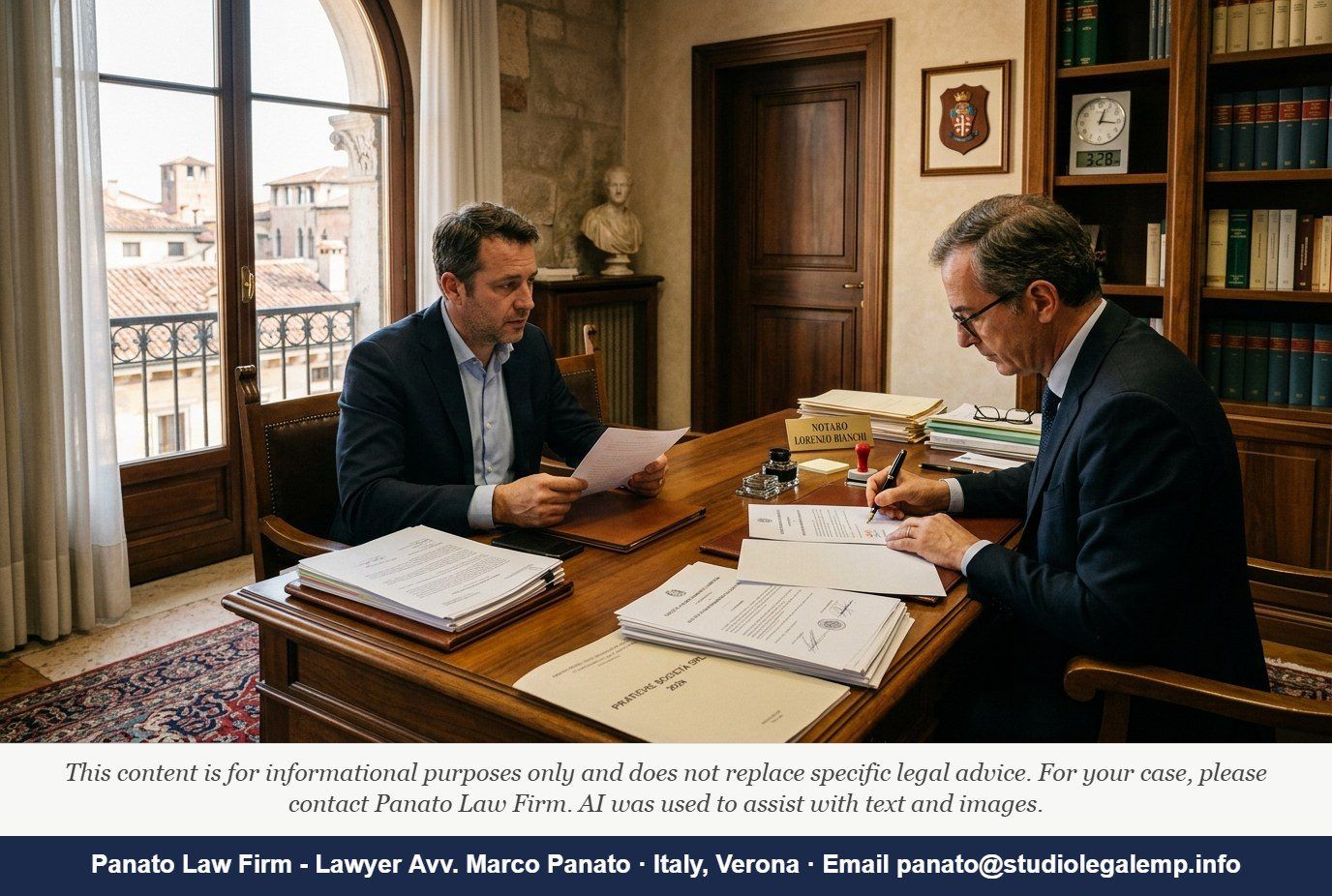
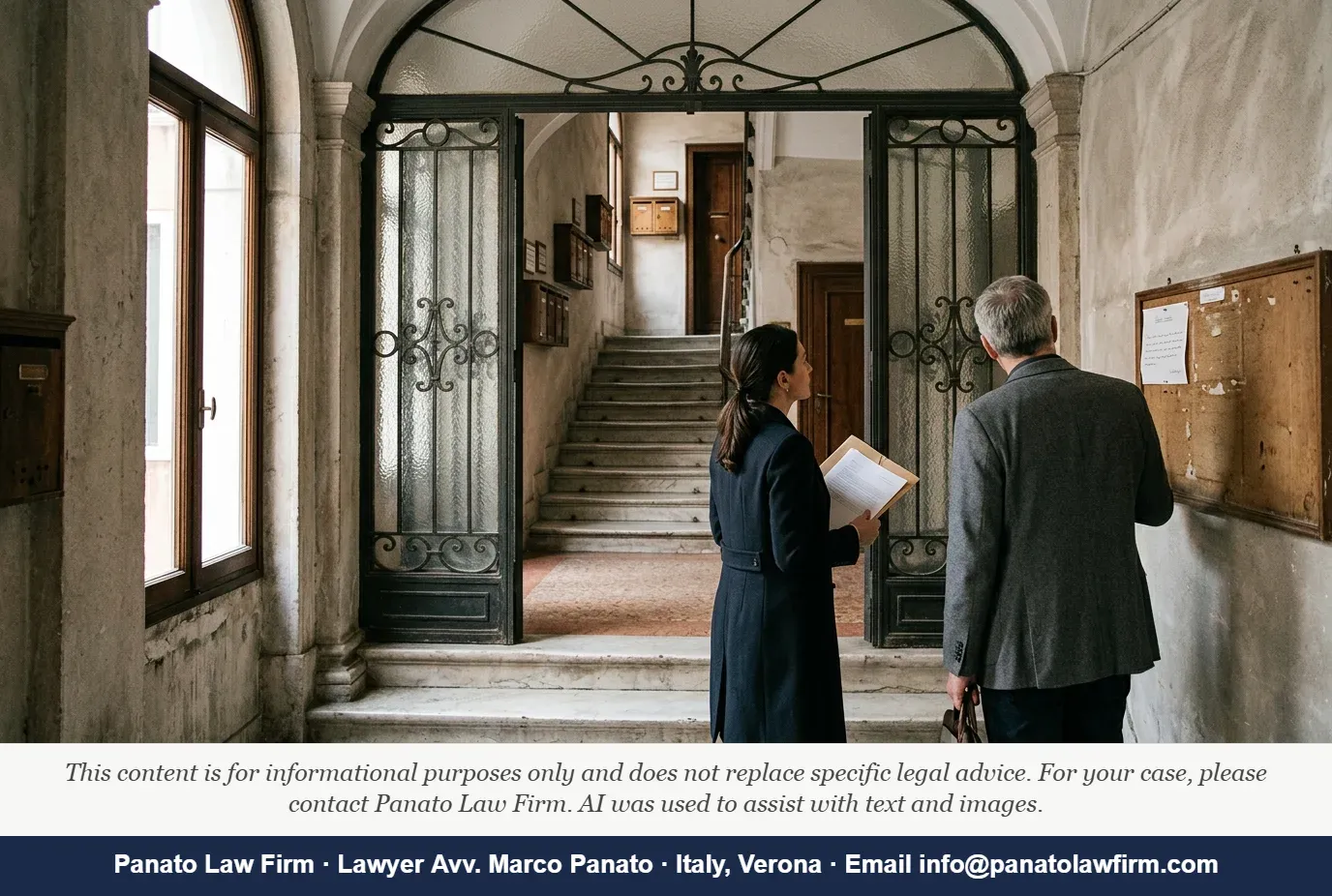
Image prompt: A professional scene inside an elegant Italian notary office in Verona: a foreign entrepreneur in business attire — looking focused but slightly uncertain — sits across a wide wooden desk from an Italian notary reviewing incorporation documents. Afternoon light filters through tall Renaissance windows onto stacks of stamped papers. The colour palette is warm amber and deep burgundy with ivory paper tones. Mood: concentrated, high-stakes, institutional gravity.
Image file: set-up-company-italy-foreigner-2026-mistakes-cover
JSON-LD:
LANGUAGE QA: valid immigration title -> valid immigration status / leave to remain · channelled through Italy's annual immigration quota decree -> allocated under / governed by · the aggregate available across all non-EU nationalities combined -> a single pool shared across all non-EU nationalities · wiring the share capital -> transferring / paying up the share capital · the articles of association are fixed by ministerial model -> the articles of association follow a prescribed statutory template · measurable scalability -> demonstrable scalability / clear growth potential · the correct route for founders of imprese innovative -> founders of imprese innovative should instead apply for · as most recently amended by -> as amended
CHECK:
Arts. 2462–2483 Italian Civil Code / EXISTS? Yes, confirmed via Normattiva / CONTENT MATCHES? Yes — minimum capital €10,000, 25% at incorporation, SRL governance framework.
Legislative Decree 210/2025 / EXISTS? Yes, confirmed via Normattiva and Gazzetta Ufficiale / CONTENT MATCHES? Yes — amends D.Lgs. 231/2007, AML framework reform, beneficial ownership register access restrictions.
CJEU Case C-601/20, Sovim SA v Luxembourg Business Registers, 22 November 2022 / EXISTS? Yes, confirmed via curia.europa.eu / CONTENT MATCHES? Yes — judgment on beneficial ownership register public access and Charter of Fundamental Rights.
Decreto Flussi 2026–2028 quota figures (164,850 total; ~500–650 self-employment) / EXISTS? Partially confirmed — total quota confirmed; self-employment sub-quota is consistent with prior-year decrees and press reporting but the precise 2026–2028 figure should be verified against the DPCM text. Flagged TO VERIFY above.
Law 221/2012 (Italia Startup Visa) / EXISTS? Yes, confirmed via MIMIT and invitalia.it / CONTENT MATCHES? Yes — innovative startup definition, outside-quota visa route.
OVERALL: AMBER — four of five authorities fully confirmed; Decreto Flussi self-employment sub-quota is consistent with available sources but the exact figure for 2026–2028 should be verified against the official DPCM before publication.
LOCAL NOTE:
1. Search intent: informational, with strong transactional signal (founders actively planning incorporation who need to identify and avoid specific legal and procedural errors before committing).
2. Local-market framing: the article targets UK, US, Australian and Canadian entrepreneurs who intuitively assume that company ownership confers residency rights, as it largely does in their own systems; the contrast passage makes this assumption explicit and corrects it directly against the Italian immigration quota reality.
3. Italian terms kept: <i>notaio</i> retained on first use to signal the uniquely Italian nature of the role (not equivalent to a notary public in common-law systems); <i>Click Day</i> kept as a widely used colloquial term for the Decreto Flussi application window, explained in context; <i>stabile organizzazione</i> retained once in the branch/subsidiary section alongside its English equivalent permanent establishment for readers familiar with OECD terminology.
Do you need legal assistance or a free estimate?
Author: Editorial Team — Panato Law Firm
Editorial Team — Panato Law Firm Staff