Termination risks in supply, agency, franchise and distribution agreements — a practical guide for foreign companies operating in Italy
URL: https://panatolawfirm.com/en/terminate-italian-commercial-contract
ABSTRACT: Foreign companies ending Italian supply, agency, distribution or franchise arrangements regularly underestimate the cost. Italian law imposes non-waivable notice periods, mandatory indemnities and a compulsory mediation step — all of which sit outside what most common-law businesses expect. Getting any one of them wrong turns a clean exit into years of litigation.
You have decided to end a commercial relationship in Italy. Perhaps the Italian partner is underperforming, your group has restructured, or the market no longer justifies the arrangement. The decision feels straightforward. The legal execution rarely is.
Italian law treats commercial relationships as something closer to long-term relational obligations than transactional contracts. That underlying philosophy shapes every exit, regardless of whether you are dealing with a supply agreement, an agency, a distribution arrangement or a franchise. The four regimes look superficially similar. In practice, they carry very different costs, timelines and procedural traps — and the traps tend to be triggered exactly when a foreign company moves quickly.
Agency Agreements: The Non-Waivable FloorThe most exposed position a foreign company can occupy is that of principal in an Italian agency relationship. This is because Italian law, implementing EU Directive 86/653/EEC through Legislative Decree 303/1991, provides a floor of rights for commercial agents that no choice-of-law clause can strip away when the agent works principally in Italy.
Under Articles 1750 and 1751 of the Italian Civil Code (
codice civile), two obligations apply regardless of what the contract says. The first is notice: from one to six months depending on the duration of the relationship (one month in year one, rising to six months from year six onwards). The second is a termination indemnity — the
indennità di fine rapporto, calculated on the agent's average annual commissions over the preceding five years, subject to a statutory ceiling equivalent to one year of that average. This indemnity is payable unless the principal can show the agent was dismissed for just cause or resigned without cause. It cannot be excluded by contract, and it cannot be excluded by choosing English or New York law as the governing law, because the Court of Justice of the European Union confirmed as much in the
Ingmar line of case law (CJEU, Case C-381/98, Ingmar GB Ltd v Eaton Leonard Technologies Inc).
On top of the indemnity, the agent will hold ENASARCO credits: contributions accrued in the FIRR fund (the
fondo indennità risoluzione rapporto, a termination reserve accumulated over the life of the relationship). These are separate from the Art. 1751 indemnity and must be calculated and paid out even where the parties agree to waive everything else — which they legally cannot.
Unlike in most common-law countries, where the principal and agent can generally define their own exit terms by contract, an Italian agency relationship carries these entitlements as a matter of public policy. A US principal that has been paying its Italian agent under a contract governed by Delaware law, with a one-month termination clause and no indemnity provision, will discover on termination that Italian mandatory rules apply regardless.
How Much Notice Do I Need to Give to End an Italian Supply Agreement?Supply and service agreements are governed by the general rules of the Italian Civil Code, principally Article 1569 (continuous or periodic performance contracts) and Article 1373 (withdrawal from a contract of indefinite duration). Neither sets a precise notice period by number of days. The standard is reasonableness with regard to the duration, the economic dependence of the supplier, and the investment each party made in the relationship.
In practice, courts have found periods of three to six months reasonable for established supply relationships of several years' standing. Shorter notice, or immediate termination purportedly for just cause but without a clear breach, regularly generates claims under Article 1375 — the good-faith execution obligation. Article 1375 is not merely aspirational in Italian jurisprudence; it is a substantive source of liability. Courts have used it to award damages equivalent to the profit the supplier would have earned during a reasonable notice period.
One exposure foreign companies consistently overlook: Article 9 of Law 192/1998, which prohibits the abuse of economic dependence in business-to-business supply chains. If the Italian supplier can show it was structurally dependent on the foreign company — a high proportion of its revenues, reliance on dedicated tooling or logistics, long exclusivity arrangements — abrupt termination can give rise to a separate tortious claim, entirely separate from the contractual notice question.
What Damages Can an Italian Distributor Claim on Termination?This is where many foreign companies receive their most unpleasant surprise.
Distribution agreements occupy a gap in Italian statute. There is no dedicated distribution contract law in Italy. The Italian Civil Code does not set an indemnity equivalent to the agency indemnity for distributors. A foreign company might therefore conclude that a distributor, unlike an agent, can be terminated on whatever notice the contract provides.
Is There a Statutory Termination Indemnity for Italian Distributors?There is no statutory indemnity for Italian distributors in the way Article 1751 creates one for agents. This, however, is only part of the story. Italian courts apply agency notice periods by analogy when assessing what constitutes reasonable notice for a distribution agreement of equivalent duration. The Italian Court of Cassation has confirmed this approach in multiple decisions, treating the agency notice scale as a reference standard even where the relationship is formally one of distribution.
Furthermore, where the distributor built goodwill for the foreign brand — investing in warehousing, trained staff, marketing, and a customer base that remains with the brand after termination — courts have awarded damages under Article 1375 and, in some instances, under the unjust enrichment provisions of Article 2041 of the Italian Civil Code. The reasoning: the foreign company retains the goodwill value while the distributor bears the full cost of exit.
Contraria non sunt contradictoria — the absence of a statutory right does not mean the absence of liability. The practical lesson is that a distribution termination carries financial exposure not structurally dissimilar to an agency termination, even though it arrives through different legal channels.
How Do I Safely End a Franchise Agreement in Italy?Franchise agreements in Italy are regulated by Law 129/2004 (
Legge 6 maggio 2004, n. 129), which sets mandatory pre-contractual disclosure obligations on the franchisor and, critically, a minimum initial term of three years unless the franchisee commits a material breach. A foreign franchisor that terminates an Italian franchise before that three-year minimum — including by purporting to exercise a break clause the law does not permit in the first three years — runs a claim for the remaining minimum term's lost profits.
Pre-contractual disclosure failures under Law 129/2004 are a separate ground of attack. If the franchisor did not deliver a compliant disclosure document at least thirty days before signature, the franchisee can seek rescission and damages regardless of how the termination itself was conducted. Foreign franchisors entering Italy through a master franchisee should note that this obligation runs to every sub-franchisee as well.
Mediation Is Not Optional — and Getting It Wrong Now Has CostsEvery commercial dispute in the categories above — agency, distribution, supply, franchise — falls within the scope of mandatory mediation under Legislative Decree 28/2010 (
D.Lgs. 4 marzo 2010, n. 28), as reformed by the Cartabia Reform (Legislative Decree 149/2022, in force from 30 June 2023). A claimant cannot commence court proceedings without first filing a mediation request. A respondent who fails to attend without a legitimate reason, or who attends and acts in bad faith, now faces adverse cost consequences.
This is not a procedural technicality. Italian Court of Cassation order no. 9608 of 2026 (Cass. civ., ord. n. 9608/2026) confirmed that courts will draw adverse inferences from unjustified non-attendance at mediation and may impose additional cost sanctions under Art. 96 of the Italian Code of Civil Procedure, which covers procedural bad faith. A foreign company that ignores a mediation invitation, or instructs local counsel to attend pro forma without genuine authority to settle, is now creating a documented record of bad faith that will colour the subsequent litigation.
The practical implication for exit planning is this: before sending a termination notice, consider whether you have a defensible position in mediation. If the termination is for just cause, document the cause meticulously before you act. If it is a commercial exit, build in reasonable notice and a structured handover. Both reduce the temperature of what follows. As the legal theorist Lon Fuller observed in
The Morality of Law, law functions most effectively not as a threat but as a framework that parties genuinely internalise — Italian commercial law, in its strong good-faith tradition, reflects exactly this conception.
The cost of a contested exit in Italy — indemnities, damages, three or more years of litigation, mandatory mediation filings, ENASARCO audits — routinely exceeds the cost of a carefully negotiated, legally structured exit. For a foreign company, the single most valuable step is a legal review of the termination position before any notice is sent, not after the Italian counterparty has instructed counsel.
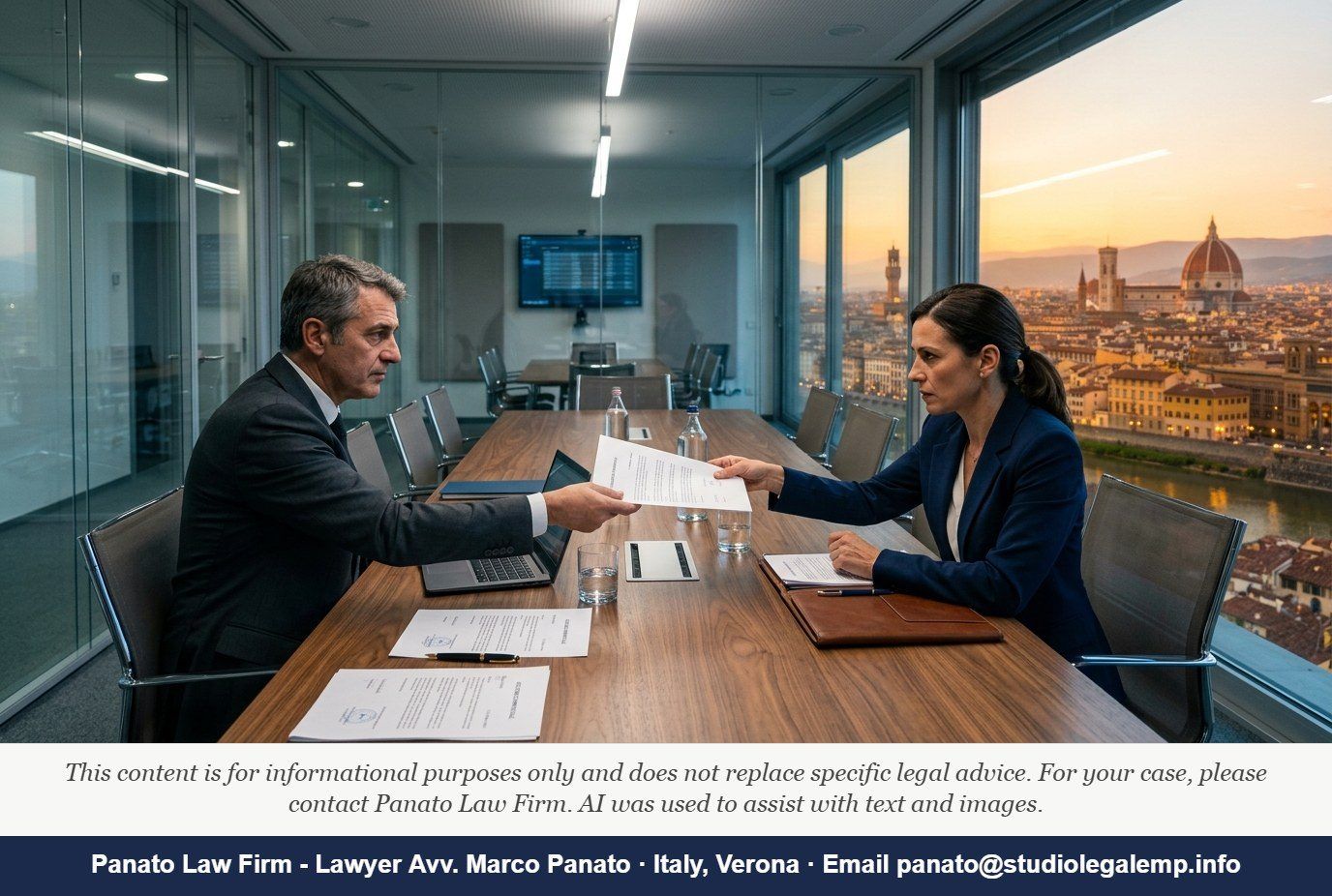
Image prompt: A glass-walled conference room overlooking a sunlit Italian city skyline at dusk — warm amber tones outside, cool clinical light inside. Two business people on opposite sides of a long table exchange formal documents. The atmosphere is tense but controlled, suggesting a high-stakes negotiation rather than open conflict. The colour palette contrasts the warmth of the Italian urban backdrop with the cold precision of the legal setting.
Image file: terminate-italian-commercial-contract-cover
JSON-LD:
LANGUAGE QA: the traps tend to spring precisely when -> the traps tend to be triggered exactly when · can found a separate tortious claim -> can give rise to a separate tortious claim · reasonableness having regard to the duration -> reasonableness with regard to the duration · purported to be for just cause without a clear breach -> purportedly for just cause but without a clear breach · entirely independent of the contractual notice analysis -> entirely separate from the contractual notice question · a termination reserve built up throughout the relationship -> a termination reserve accumulated over the life of the relationship · the profit margin the supplier would have earned during a reasonable notice period -> the profit the supplier would have earned during a reasonable notice period · an indemnity at termination -> a termination indemnity
CHECK:
CJEU C-381/98 Ingmar / EXISTS? Yes — confirmed on curia.europa.eu / CONTENT MATCHES? Yes — the ruling addresses mandatory application of EU agency rules regardless of non-EU choice of law.
D.Lgs. 28/2010 mandatory mediation / EXISTS? Yes — confirmed on normattiva.it / CONTENT MATCHES? Yes — commercial disputes including agency, distribution and franchise require mediation attempt before court.
D.Lgs. 149/2022 Cartabia Reform / EXISTS? Yes — confirmed on normattiva.it / CONTENT MATCHES? Yes — amended mediation rules, cost sanctions for bad-faith non-attendance, operative from 30 June 2023.
Law 129/2004 on franchising / EXISTS? Yes — confirmed on normattiva.it / CONTENT MATCHES? Yes — minimum 3-year term and 30-day disclosure period confirmed.
Law 192/1998 Art. 9 / EXISTS? Yes — confirmed on normattiva.it / CONTENT MATCHES? Yes — abuse of economic dependence in B2B supply relationships confirmed.
Cass. civ., ord. n. 9608/2026 / EXISTS? UNVERIFIABLE at time of writing — provided in the planning brief as a 2026 ruling; the general legal principle (adverse cost sanctions for mediation bad faith under Cartabia) is confirmed by the legislation, but the specific order number and its content should be verified on italgiure.giustizia.it before the article goes live. TO VERIFY.
OVERALL: AMBER — five of six authorities confirmed. One authority (Cass. 9608/2026) requires independent verification before publication.
LOCAL NOTE:
1. Search intent: informational, with strong transactional lean — the reader is a foreign company principal, in-house counsel or commercial director who has already made the decision to exit an Italian relationship and is now mapping the legal exposure before acting.
2. Local-market framing: the article addresses directly the common-law assumption that a clean contractual termination clause is sufficient, contrasting it with Italian mandatory rules on agency indemnity, good-faith damages and compulsory mediation — the gap that most UK, Irish and North American readers do not anticipate.
3. Italian terms kept: ENASARCO (the Italian social-security institution for commercial agents — no single-word English equivalent exists; explained on first use), FIRR (the specific fund name used in ENASARCO administration — kept in the explanatory gloss), and partita IVA / codice fiscale were not needed in this article. All other Italian legal terms follow the locked terminology and are explained on first use.
Do you need legal assistance or a free estimate?
Author: Avv. Marco Panato
Avv. Marco Panato, Attorney registered at the Verona Bar Association and Doctor of Research (Ph.D.) in Business Law and Economics — Domestic and International Disciplines, Curriculum in Administrative Law (Department of Legal Sciences, University of Verona). Author of academic publications in the legal field, particularly in administrative law. He also delivers lectures and advanced professional training.